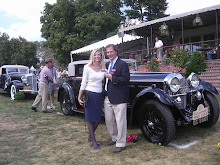
The Cisitalia is I think one of the most elegant car designs of the 20th century. The Pinin Farina body lines looks as good today as they did in 1947. Our car in the photo is the actual car that was on display in 1951 at the Museum of Modern Art in NYC . The car was shown earlyer this month at the Radnor Hunt Concours. My friend Tre was there at the event helping me judge the cars.
Here is more on the Cisitalia 202 from Wikipedia
Ducio provided Pinin Farina with the chassis on which the Cisitalia's body was placed. The body was more or less handcrafted, with its aluminum panels shaped over wooden forms. Because of this time-consuming process, only 170 models were produced between 1947 and 1952. When first presented to the public at the Villa d'Este Gold Cup show in Como, Italy, and at the 1947 Paris Motor Show, the Cisitalia "202" GT was a resounding success. The two-seater Cisitalia "202" GT was an aesthetic and technical achievement that transformed postwar automobile body design. The extraordinary Pinin Farina design was honored by New York's Museum of Modern Art in 1951. In the MOMA's first exhibit on automotive design, called "Eight Automobiles", the Cisitalia was displayed with seven other cars (1930 Mercedes-Benz SS tourer, 1939 Bentley saloon with coachwork by James Young, 1939Talbot-Lago Figoni teardrop coupé, 1951 Willys Jeep, 1937 Cord 812 Custom BeverlySedan, 1948 MG TC, and the 1941 Lincoln Continental coupe). It is still part of the MoMA permanent collection [1].
Building on aerodynamic studies developed for racing cars, the Cisitalia offers one of the most accomplished examples of coachwork (the automobile's body) conceived as a single shell. The hood, body, fenders, and headlights are integral to the continuously flowing surface, rather than added on. Before the Cisitalia, the prevailing approach followed by automobile designers when defining a volume and shaping the shell of an automobile was to treat each part of the body as a separate, distinct element—a box to house the passengers, another for the motor, and headlights as appendages. In the Cisitalia, there are no sharp edges. Swellings and depressions maintain the overall flow and unity, creating a sense of speed.
For more information and help with your fine art and classic car valuetions contact me at